
Blog Details
- Member
- May 9, 2026
CCUSTOMER AS HERO
A new form of value creation is
emerging where companies no longer rely on claims, campaigns, or content
volume, but on credible human narratives authored by customers themselves.
In this model, the brand does not speak for the customer; it creates the
conditions in which the customer can articulate their own transformation. What
is promised is not better marketing, but a structural shift in trust creation—from
persuasion to participation, from messaging to meaning.
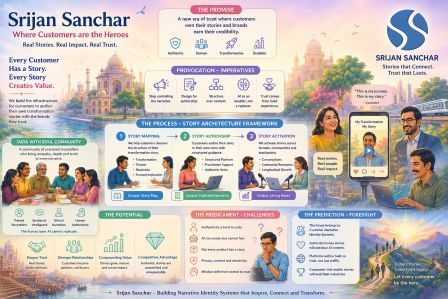
Srijan Sanchar’s framework offers
this as a managed system: a way to build a living narrative identity layer
where each customer story is real, owned, and connected to a larger architecture
of experience. Over time, this becomes a compounding asset that no competitor
can replicate through technology alone.
Provocation
(Imperatives)
If this direction is to succeed,
certain imperatives must be accepted.
Companies must stop attempting to
control the narrative and instead design for authorship. Customers
should not be reduced to testimonials; they must be enabled as narrators of
their own journeys.
Content must give way to structure.
Without a clear narrative architecture, stories remain anecdotal and lose
power.
AI must be repositioned—from
generator to enabler of depth and scale. Authenticity cannot be
simulated; it must be surfaced and supported.
Finally, organisations must
recognize that trust will not come from frequency or visibility, but from verifiable
lived experience expressed in the customer’s own voice. This requires a
shift not just in tools, but in intent.
Process
The Srijan Sanchar Story
Architecture Framework operationalizes this through a three-layer system.
The first layer, Story Mapping,
helps the customer understand the structure of their own experience. Through
guided conversations, the transformation, tension, and forward implication are
identified. The customer does not receive a ready-made story but gains clarity
on the story they already possess.
The second layer, Story Authorship,
enables the customer to articulate this experience in their own voice using a
structured environment. The Srijan Sanchar portal provides the framework, while
the Data with Soul community supports the process through facilitation rather
than intervention. The result is a narrative that is both structured and
authentic.
The third layer, Story Activation,
ensures that the story becomes a living asset. Through conversations, community
integration, and periodic evolution, the narrative remains dynamic. Over time,
individual stories connect into a larger system—a coherent body of lived experience
that grows in credibility and depth.
Potential
If executed well, this approach
creates a new category of value.
For organisations, it builds a trust
architecture that compounds over time. Each story strengthens the next,
creating a network of credibility rather than isolated proof points.
For customers, it creates
recognition and ownership. They are no longer passive recipients of messaging
but active participants in meaning creation.
For networks, it generates
high-quality signals. Stories that are real, structured, and relatable travel
further and create deeper engagement.
At scale, this can transform
industries—especially in domains where outcomes matter more than features, such
as professional services, education, health, and complex B2B systems.
Predicament
(Challenges)
The path is not without difficulty.
Authenticity cannot be automated
easily. Over-reliance on AI risks producing narratives that feel templated or
artificial. Maintaining the balance between scale and truth is a constant
challenge.
Not all organisations are suited for
this model. Where the customer relationship is transactional, there is no
meaningful story to tell. Attempting to force narratives in such contexts leads
to dilution and loss of credibility.
There are also operational
challenges: training facilitators, maintaining community quality, ensuring
consistency of structure, and respecting privacy and consent.
Most importantly, this approach
requires a shift in mindset. Organisations must be willing to relinquish
control and accept that the most powerful stories may not always align
perfectly with their preferred messaging.
Prediction
(Foresight)
The trajectory is clear.
Markets are moving from content
saturation toward credibility scarcity. As AI increases the volume of
generated content, the value of authentic human experience will rise sharply.
In the near future, leading
organisations will not differentiate through products or even through
knowledge, but through trusted narrative ecosystems—systems where
customer experiences are continuously captured, structured, and shared.
Platforms like LinkedIn and WhatsApp
will act as amplification layers, but the core asset will be independently
structured narrative repositories such as the Srijan Sanchar portal.
Over time, this will evolve into a
new competitive frontier: Customer Narrative Identity Systems.
Organisations that build these early will possess a durable advantage, as their
credibility will be rooted not in claims, but in a continuously growing body of
lived, verifiable human experience.
Closing
Insight
What is being proposed is not a new
storytelling technique, but a new infrastructure for trust—where the
smallest unit of value is not a message, but a human story that is real,
structured, and allowed to travel.